

nanogram: The Social Network Where You… Create?!
A social network where you don't just share and hate but build your own games with a single sentence. nanogram started in Bulgaria and, in just a few months, has drawn 750,000 users and $2.2 million from investors. Two of its creators, Ognyan Trayanov and Boris Radulov, tell the story.
 02
Transform Your Site!
For a long time I told myself this site was too complicated to update, speed up and make modern… and then it happened in just a few hours. After that came the English version, a newsletter of my own and several more sites.
 03
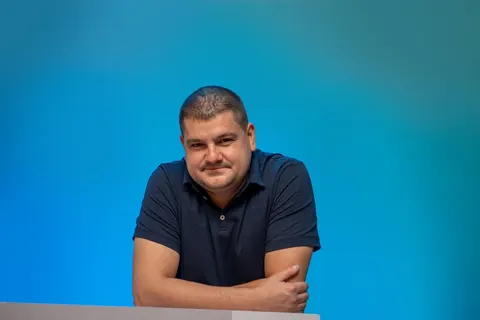
“Bulgaria Has a Huge Chance If It Seizes Today’s Technological Revolution”
The fifth industrial revolution has already begun, and for the first time we have the chance of an equal start with everyone else—as a country, as companies and as individuals. How do we make the most of it? A conversation with Dobroslav Dimitrov.
 04
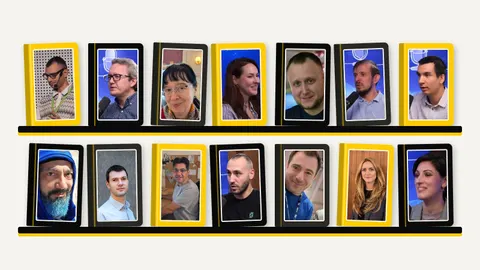
“Why We Sleep”: IT Leaders’ Book Picks for Buditeli Day
A successful entrepreneur, visionary and philanthropist. A professor of computer science in Canada. A Frenchman who has lived in Sofia since 2008 and makes games. A team lead who also takes hiking groups out as a mountain guide. What could their favorite books be?
 05
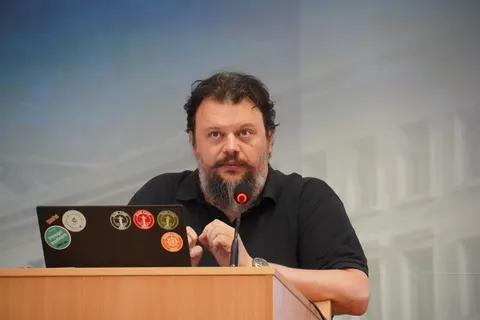
The Logic of Emotions: Why We Hate, and How to Stop
Two IT people sat down… to talk about communication. Technologies change; the people who use them don't. Why does a programmer with 20 years of experience insist that the most important skill in his profession is understanding people? And what does that have to do with hate on social media and with artificial intelligence?
 06
“AI Is No Better a Programmer Than the Ones You Already Have!”
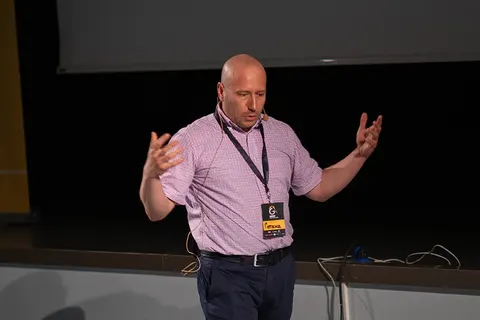
“However we integrate AI, in the end every line of code has to be read by a human.” “It is sheer madness to believe that general AI can be achieved with large language models.” “The world as we knew it is dead, and it isn’t coming back.” Ivan Vankov (Gatakka) can always be counted on for an original, unorthodox, provocative and thought-provoking take on technology, as the lines that follow will show.
 07
Why Is Everyone Listening to Andrej Karpathy?
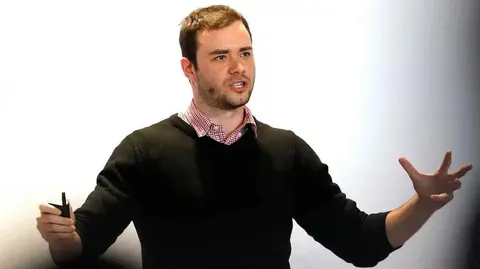
“There’s a new kind of coding I call ‘vibe coding,’ where you fully give in to the vibes, embrace exponentials, and forget that the code even exists.” With those words, on February 2 of last year, a world-famous programmer founded an entirely new field: a world in which software is made not by writing code but by explaining in human language. Andrej Karpathy, a co-founder of OpenAI and a builder of Tesla’s self-driving cars, has just joined Anthropic. What future does he see, and what kind of man is one of the prophets of the age of advanced artificial intelligence?
 08
“We’re Already Generating a Tremendous Amount of Chaff”
Can we stop the cognitive decline that comes with the enormous progress of artificial intelligence, and how? Can the pendulum of cognitive decline, of over-trusting technology, of a broken public conversation swing back, and how? We pit the optimistic and the pessimistic views against each other on the biggest question this site exists for. Prof. Julita Vasileva is a world-renowned researcher in computer science and in our interaction with technology. We met five years ago to talk about the filter bubble and about the way we interact and get informed online. Today she is researching an equally important and even hotter topic: can we turn the techniques of online manipulation against their creators?
 09
The Day Programmers Stopped Writing Code
In just one month, some of the undisputed authorities from different generations and corners of the computer world rallied behind the same idea. Today, humans no longer need to write computer code, because artificial intelligence already does it better than we do. This Digital Story matters not only to the tens of millions of programmers but also because it is a powerful example. It is unfolding in the software world, but there is no reason it won't repeat itself in every other field where AI is arriving more slowly, yet just as relentlessly. Maybe it's time to “get off” our keyboards. But… what do we take up then? What will programmers do when they no longer write code?
 10
Will There Be a Bulgarian Author? Book Picks from IT Leaders, Part III
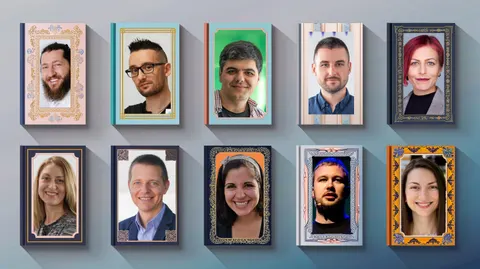
Would you have guessed that Bulgarian IT leaders read Harry Potter, or even Dostoevsky? I wouldn't have, at least until a week ago, when I asked them and it turned out they do. On the eve of the Day of the Buditeli, I invited 30 remarkable people to recommend three favorite books to the readers of Digital Stories, and today I present the second half of their answers.
 11
“Engineers Will Always Be in Demand. But Our Skills Have to Change”
Work in the software world has already changed fundamentally with the arrival of artificial intelligence. On November 29, at the conf.ai workshop, Djemal Ahmedov will harness AI agents and make them work as an entire software team. Before that, we talk about the chaotic present and uncertain future of software in the age of advanced AI, and about whether there will always be a human in the loop.
 12
From Dostoevsky to Harry Potter: What Bulgaria's IT Leaders Read
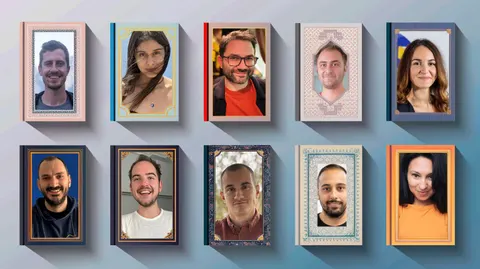
I sent a short invitation to 30 IT figures I find remarkable: recommend three of your favorite books to the readers of Digital Stories. I tried to make the lineup of guests as varied as possible, from people in leadership roles to well-known speakers, from those working across the ocean to foreigners the industry has brought to Bulgaria, representing the widest range of technologies and different generations. Get ready for some stereotypes to blow up! I received no fewer than 20 replies, and I have the pleasure of presenting them to you! Once again they amazed me with their variety, their range and their depth, and they gave me plenty of ideas for future reads to add to my Goodreads list. Today I present the recommendations of the first ten guests; the rest will follow in a week. They aren't grouped by any particular logic—they simply turned out too varied and unexpected for that—so I offer them in the order I received them. Happy reading!
 13
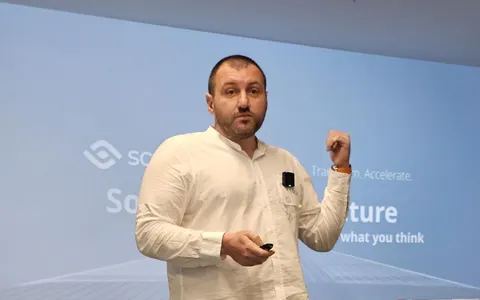
“We Can No Longer Think Only About Endless Growth!”
“Right now we don't have the conditions for AI to develop dramatically,” says Krasimir Kostadinov, chief technology officer of Scalefocus, who argues that the future of IT has aspects even more important than artificial intelligence. After his provocative talk at the 9th DEV.BG All in One conference, we continued the conversation about the Bulgarian dimensions of the IT future. Is it worth entering IT in Bulgaria today, and which qualities matter in the dynamic times we live in?
 14
“Right Now, the Conditions Simply Aren't There for AI to Make a Dramatic Leap”
With Krasimir Kostadinov you can talk about geopolitics, astrophysics and history, all in the context of technology, the march of time and the trends that shape all our lives. He is the chief technology officer of Scalefocus: an engineer, architect and programmer with wide-ranging interests and deep knowledge, which he often shows off in his tech blog. In his current role, one of his direct duties is… to peer into the future, trying thoughtfully, sensibly and from every angle to predict where technology is taking us. We will peer into the future with him, for a sober and very different look at AI and the other big themes of the new age. Join us for a stroll through what lies ahead!
 15
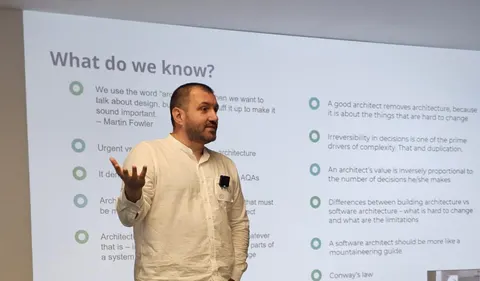
“I Don't See Programmers Disappearing”
Minko Gechev holds a black belt in karate… and, as a seasoned senior developer at Google, in programming too. Last time we followed his fascinating path from the small Bulgarian town of Troyan to one of the software giants of our time; now we turn to some of the most exciting questions of the day: what the future of software engineering looks like from its Mecca, Silicon Valley, whether the programmer's profession will survive at all, what is worth learning today and whether we can prepare for an exciting but challenging future. And how does our guest rediscover the wisdom of the East at the very heart of Western technology?
 16
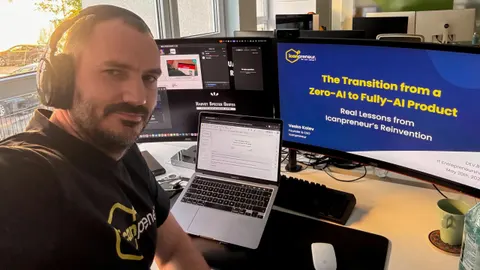
“Let’s Stop Underestimating Ourselves!”
Two programmers sit down to talk about our broken public conversation, about division and about the road to success. It sounds like the start of a joke, but it became a serious, thought-provoking interview with Vesko Kolev, head of the startup Icanpreneur, on the DEV.BG podcast. We talk about why we need to start listening and talking to each other again, why it is worth being glad when your child gets a bad grade, and what we need as a society to move forward together in the age of advanced artificial intelligence.
 17
“Hard to Be a God”: What Do Bulgaria's Tech Leaders Read?
Do the people who drive the world of information technology forward actually read? They read like there's no tomorrow, and you're in for a surprise. Time for a very important and very bookish experiment: I asked 15 leading figures from different corners of the Bulgarian computer world to name their three favorite books and tell me why they would recommend them. Is it hard to be a god? A question for connoisseurs. And why is it hard?
 18
“It’s Crystal Clear That AI Is the Future”
The day before I met Ilia Valchanov, the news broke officially that his startup Team-GPT had secured $4.5 million in funding, a record for Bulgaria! Today’s guest leads a platform that helps businesses around the world use the power of large language models while keeping their data safe and confidential. It is far from his first impressive achievement: for years Ilia has been building hugely successful online courses in data science and artificial intelligence, and he personally has more than 1,400,000 students on Udemy! He owes his remarkable success to a thorough approach, a great deal of reading and learning, courage and unconventional decisions. That is why we are meeting: to talk about the next big news coming out of the world of artificial intelligence. About how the technology will transform every area of business, but also about the risks it creates. About the important causes tied to the progress of AI, and the skills it will never manage to develop.
 19
Ward Cunningham, Warden of the Free Internet
“The best way to get the right answer is not to ask a question. It is far more effective to post the wrong answer.” And everyone will rush to correct you, to jump into the argument, right? That is Cunningham’s Law, a fascinating rule about how online communication has changed us. But who is this Cunningham? One of the pioneers of the democratic internet, he paved the way for Wikipedia and for online opinion-sharing systems, co-wrote the Agile Manifesto, and gave us concepts such as technical debt and extreme programming.
 20
A Stuntman Takes On the Hackers
Which is harder—knocking out Antonio Banderas or fending off the cyberattacks aimed at a large company? There can hardly be more than one person in the world who can answer that from personal experience. Only our guest today. Veselin Troyanov has worked as a stuntman on countless Hollywood blockbusters, alongside Jason Momoa, Scarlett Johansson, Gary Oldman, Ryan Reynolds and Antonio Banderas. Today he heads the Bulgarian team of Check Point, a global cybersecurity company with vast experience, while also building his own platform for influencers. Yes, we will talk about security and incidents. About risk and caution. About stuntmen and the spectacular crashes anyone can arrange for themselves by not being careful enough online… And can there be such a thing as safety on the internet at all?